


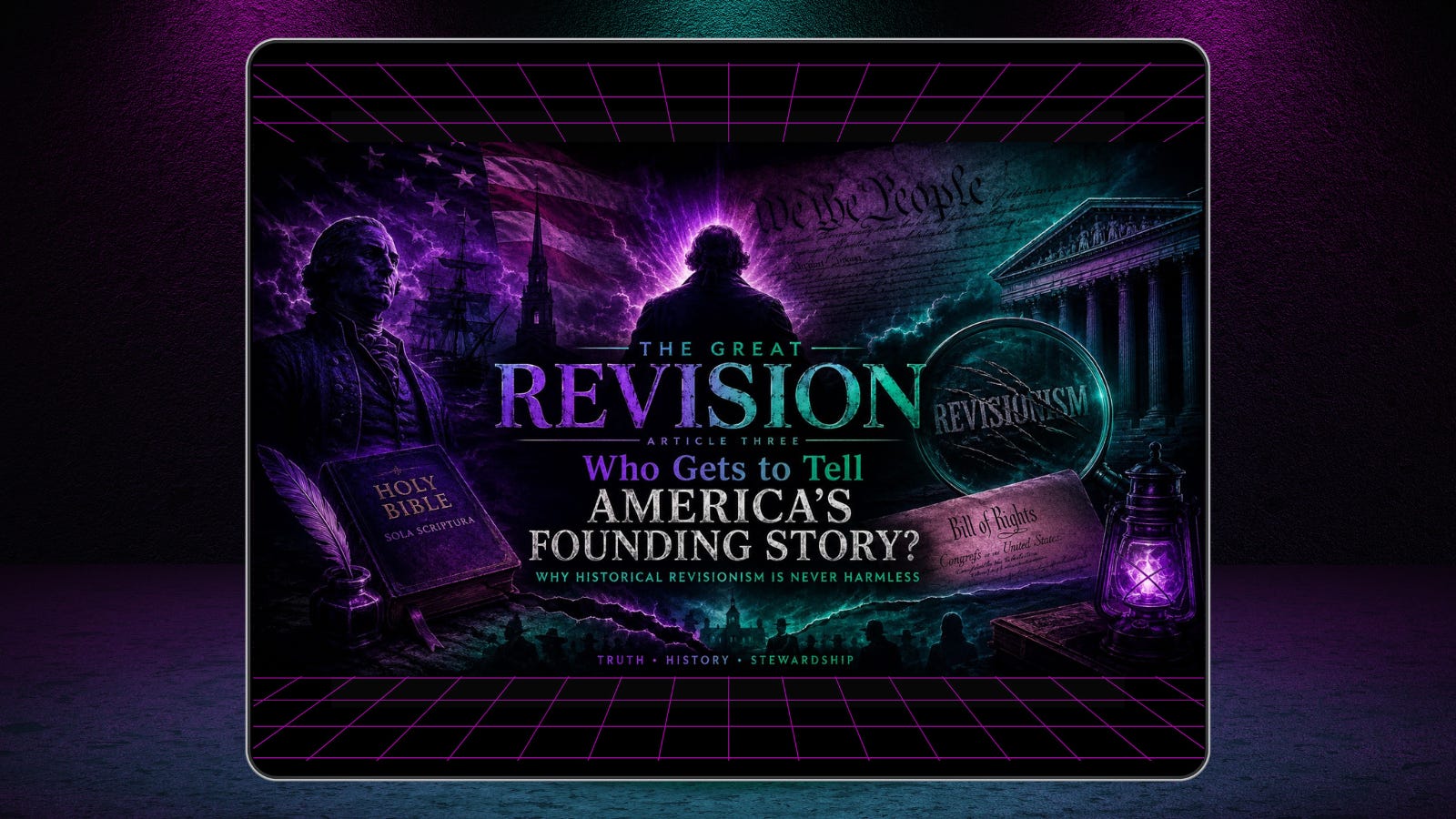
🇺🇸 America at 250
A Series on the Moral, Theological, and Historical Foundations of American Liberty

Firstly: Go back and read Article 1 and Article 2 - this is Article 3.
“Moreover it is required in stewards, that a man be found faithful.”
— 1 Corinthians 4:2
America’s 250th anniversary has prompted renewed conversations about our nation’s history, identity, and future. That is a good thing. Every generation should pause to remember the blessings it has inherited and to ask whether it has been a faithful steward of them.
Yet remembrance requires more than celebration.
It requires truth.
History is never merely about the past.
History shapes identity.
Identity shapes institutions.
Institutions shape culture.
Culture shapes the future.
For that reason, historical narratives are never neutral. Every civilization tells a story about its own beginning. That story becomes the lens through which later generations understand their laws, their liberties, and their purpose. Change the founding story, and over time you change the nation itself.
Christians should understand this better than anyone.
Throughout Scripture, God’s people are repeatedly commanded to remember His mighty works, to teach them diligently to the next generation, and to refuse every attempt to exchange truth for falsehood. Memory is not simply an intellectual exercise; it is an act of faithful stewardship.
America now stands at such a moment.
As our nation enters its 250th year, the question is no longer merely what the Founders believed.
The question is whether we will faithfully remember what they believed or gradually replace that inheritance with another story.
That question matters because historical revisionism is never merely academic.
It reshapes memory.
It reshapes identity.
And eventually, it reshapes the nation itself.
Competing Narratives of America’s Founding
Recent public speeches commemorating America’s approaching 250th anniversary illustrate why this conversation matters.
Secretary of State Marco Rubio recently presented1 a sweeping historical narrative in which Catholic exploration, Catholic settlement, Catholic philosophy, and America’s constitutional founding are woven together into a single civilizational story. He reminded listeners that Christopher Columbus sailed under Catholic patronage, that Spanish Catholics established St. Augustine, that Catholic missionaries explored large portions of North America, and that Catholic figures participated in America’s broader historical development.
Many of those historical facts are true.
Catholic explorers, missionaries, settlers, soldiers, immigrants, and public servants unquestionably occupy an important place in the history of North America and the United States.
The historical question, however, is not whether Catholics contributed to American history.
They did.
The question is different.
What theological tradition most profoundly shaped the constitutional order established in 1776 and 1787?
Those are not the same historical question.
Exploration is not constitutional formation.
Settlement is not political philosophy.
The presence of multiple traditions is not the same thing as identifying the theological framework that most deeply shaped America’s understanding of liberty, conscience, law, and civil government.
History deserves those distinctions.
Faithful stewardship requires that we preserve them.
What the Historical Record Actually Shows
Political scientist Samuel P. Huntington, writing about American national identity rather than defending a particular denomination, observed that for more than two centuries Americans understood their national identity in distinctly Protestant terms. He wrote that:
“for more than two hundred years Americans defined their identity in opposition to Catholicism” and described the United States at its founding as “the prototypical Protestant country.”
He further noted that by 1789 approximately one percent of Americans were Roman Catholic while the overwhelming majority identified as Protestant. Only through later immigration and the gradual Americanization of Catholicism did America’s religious landscape substantially change.2
Huntington’s observations are significant because he is not writing as a Protestant theologian. He is describing the historical development of American national identity.
The colonial record reflects this reality.
Throughout much of the colonial period, several colonies restricted Roman Catholics from holding public office, limited certain civil privileges, and discouraged Catholic immigration. Those laws reflected widespread Protestant concerns about papal supremacy and divided political allegiance. What they demonstrate is that early Americans believed the claims of papal authority were fundamentally incompatible with the constitutional order they were attempting to establish.
That history cannot simply be ignored because it is uncomfortable to modern ears.
Nor should it be exaggerated.
It should simply be told truthfully.
The Protestant Foundation
America’s constitutional order did not emerge from a philosophical vacuum.
It emerged within a civilization profoundly shaped by the Protestant Reformation.
The doctrine of Sola Scriptura taught that Scripture alone is the final, infallible authority for faith and practice.
The Reformers recovered the biblical conviction that Christ alone is Lord of the conscience.
Government possesses legitimate authority within its proper sphere.
The church possesses legitimate authority within its proper sphere.
But no earthly institution possesses final, infallible, universal authority over the conscience of man.
That conviction profoundly shaped Protestant political thought.
It influenced later understandings of limited government, covenant, constitutionalism, divided powers, and liberty of conscience.
The Declaration of Independence reflects this worldview by grounding human rights not in governments, kings, or ecclesiastical institutions, but in the Creator Himself.
Men are “endowed by their Creator with certain unalienable Rights.”
Government does not create those rights.
It secures them.
That distinction remains one of the most revolutionary political principles in human history.
It also reflects a theological conviction.
Rights come from God.
Not from earthly rulers.
Not from the Pope.
Not from institutions.
Not from the state.
Faithful Stewards of Truth
The question before us is not whether every American must become Protestant. Nor is it whether people of different religious traditions have contributed to our nation’s history. They unquestionably have.
The question is whether we will tell the truth about the theological and moral foundations that gave rise to America’s constitutional order.
Historical stewardship requires honesty.
Gratitude requires honesty.
Faithfulness requires honesty.
History is not something we are free to reinvent in every generation. It is an inheritance to be received, understood, and faithfully handed down. When we obscure the ideas that shaped our nation’s understanding of liberty, conscience, and constitutional government, we do not merely alter the past—we begin altering the future.
The Protestant Reformation was never merely an academic disagreement among theologians. It raised profound questions about the authority of Scripture, the lordship of Christ over the conscience, and the proper relationship between church and civil government. Those questions shaped centuries of Western history and profoundly influenced the constitutional principles embraced by many of America’s Founders.
That history deserves to be remembered.
Not because Protestants seek cultural triumph.
Not because we wish to diminish the genuine contributions of others.
But because truth matters.
As America enters her 250th year, Christians have an opportunity and a responsibility to become faithful stewards of the inheritance God has entrusted to us. Before we can wisely evaluate the challenges facing our nation today, we must first understand the foundations upon which it was built.
History is not merely something we study.
It is something we steward.
In the next article, we will examine why this historical question is not merely about the past, but why it has direct implications for contemporary debates surrounding religious liberty, ecumenism, and America’s constitutional future.
Soli Deo Gloria.
“For from Him and through Him and to Him are all things. To Him be glory forever. Amen.” Romans 11:36
🇺🇸 America at 250
Our latest series
📖 Article 1
Before We Celebrate America, We Must Remember Her Foundation
The Inheritance We Dare Not Lose CLICK HERE
📖 Article 2
The Battle for Liberty of Conscience
Why America’s Founders Rejected Every Earthly Claim to Ultimate Authority CLICK HERE
📖 Article 3
The Great Revision
Who Gets to Tell America’s Founding Story? CLICK HERE
Marco Rubio, speech Endowed by Their Creator: Catholicism, the Declaration of Independence, and the American Experiment at 250, symposium co-hosted by the Catholic University of America, the University of Notre Dame, and the Carroll Forum for Citizenship and Public Life, April 9, 2026.
1. Samuel P. Huntington, Who Are We? The Challenges to America’s National Identity (New York: Simon & Schuster, 2004), 92–95.